April was a busy month for the Sharing Lands team. From taking our research on the road to walking in remembrance with our Choctaw colleagues, we’ve been cementing connections and preparing for upcoming activities in Ireland. Read our reflections on an exciting month and find out what’s in store for the team this summer…
Walking the virtual Trail of Tears
On April 1st, the Choctaw Nation’s annual Trail of Tears virtual remembrance walk began. The walk began during the Covid-19 pandemic as both a commemorative event and a way of encouraging tribal citizens and others to remain active during lockdown. It has continued every year since. This year’s walk covers 366 miles (or 732,000 steps). Participants are encouraged to walk 6,000 steps a day on a journey which virtually takes them from Louisville, Mississippi, through parts of Louisiana and Arkansas before crossing into Oklahoma and finally ending at Towson, the historic terminal of the Choctaw Trail of Tears.
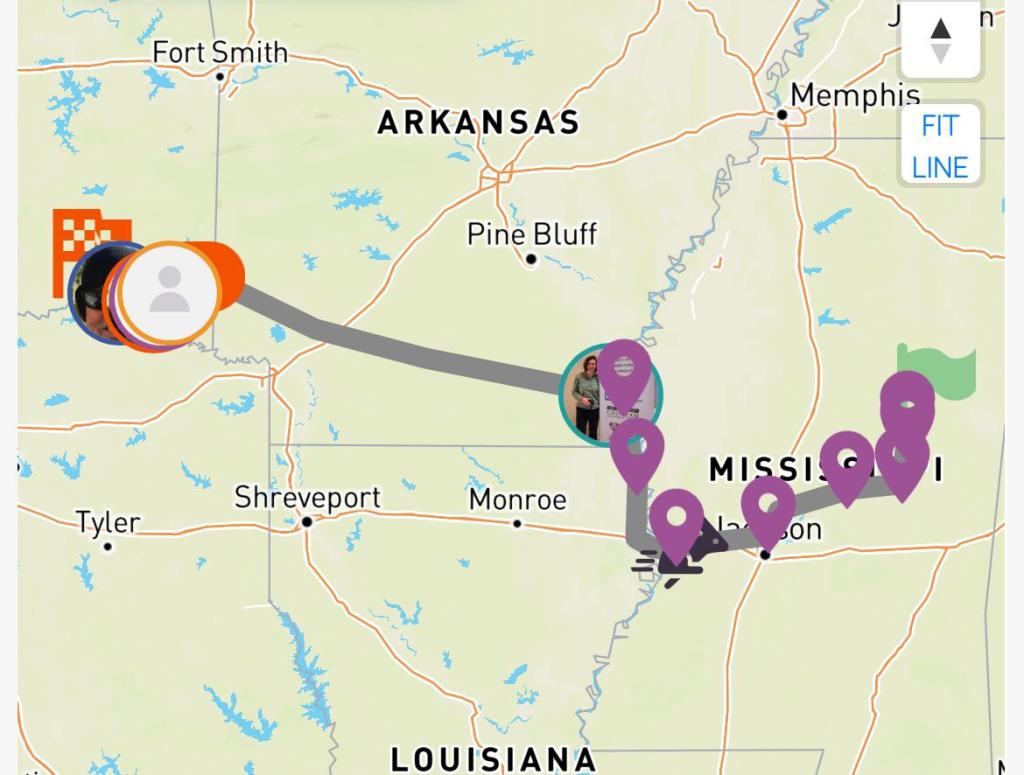
Map of the virtual route from Mississippi to Oklahoma
This year, project PI Professor Gillian O’Brien joined over 1,000 members of the Choctaw Nation in walking the journey. As participants virtually reach certain milestones on the Trail, an app records their steps and shares information about the journey that was undertaken by thousands of Choctaw in the 1830s. For example, what is now Philadelphia, Mississippi (39,919 steps along the Trail) was the village of Hanlunlawasha, or Bulldog Place, which was located on the site before the Choctaw were moved westwards. At Tvli Hatcha (Pearl River), 78,167 steps along the Trail, a notification informs participants of the importance of the river in the old Choctaw Nation. At Vicksburg, which was known as Nvnih Chaha or Hill High by Choctaw people, and located 217,933 steps along the route, participants are confronted with the brutality of the forced relocation. Professor O’Brien commented:
I learnt that those forced onto the Trail of Tears were loaded onto boats to cross the Mississippi River. Many never made it across the river as they died from cholera or the effects of cold weather before they even boarded the boats.
Professor Gillian O’Brien
Virtually walking the Trail of Tears began as a lockdown necessity but has grown into an annual challenge that anyone can join. Although our team are based an ocean away from the Choctaw Nation and ancestral homelands, by walking in community with members of the Nation we remember their journey.
Project PIs Professor Gillian O’Brien and Dr Padraig Kirwan spent some of last month in the US connecting with colleagues in the Choctaw Nation of Oklahoma to discuss the ‘Sharing Lands’ project before travelling on to New York City. At the Brooklyn Museum, the team visited an exhibition by the Choctaw-Cherokee artist Jeffrey Gibson titled ‘When Fire is Applied to a Stone it Cracks’. The exhibition’s title, inspired by an Irish phrase, features an eponymous piece comprised of acrylic, glass beads, and artificial sinew that encapsulates the ongoing relationship between the Choctaw Nation and the people of Ireland that our project delves deeper into. On the team’s return, we were pleased to find that the Irish soap opera Fair City ran a storyline that focused on the Choctaw-Irish bond. Reflecting on this feature and the team’s trip to the US, Professor O’Brien wrote a piece for RTE Brainstorm about the enduring links between the Choctaw Nation and Ireland stemming from the Choctaw Gift to the Famine Relief Fund in 1847.

Jeffrey Gibson (Choctaw-Cherokee), b. 1972. WHEN FIRE IS APPLIED TO A STONE IT CRACKS, 2019. Acrylic on canvas, glass beads and artificial sinew inset into custom wood frame, 78 × 78 in. 198 × 198 cm.
Where is the Indigenous in American Studies?
The month of April also marks the annual British Association of American Studies conference, which was held at the University of Hertfordshire this year. 2025 is the 70th anniversary of the BAAS conference, and this year the programme focused on two key strands, examining 1955 (the founding year of BAAS) as a flashpoint in American history, culture, and global impact and thinking critically about the place and significance of American Studies as a field today. During a time of increasing political instability where academic endeavours are clearly under attack, this currently feels a more pressing question than the usual reflections on the state of the field tend to offer. Indeed, BAAS itself has recently found itself on the sharp end of the present administration’s punitive executive orders. Earlier this year, the Association announced that funding for the small grants scheme, previously funded by the US Embassy, had been revoked as part of cuts to programmes that incorporate diversity, equality, and inclusion goals.

Photo by Shelley Angelie Saggar
As a project that thinks carefully about how historic administrations and policies have contributed to attempts to devastate communities, whilst also inadvertently creating and then strengthening perhaps unlikely relationships, the ambitions of the ‘Sharing Lands’ project to conduct research that is rooted in the Choctaw concept of ima, or ‘giving’ might help us to think about how Choctaw philosophies have created moments of empathy, recognition, and international alliance beyond national borders that non-Indigenous researchers might respectfully also practice in the face of such pressures. The story of the Choctaw Gift is one that refuses American mythologies of exceptionalism and protectionism, and telling that story continues to create connections that bring people closer together rather than pulling them apart.
As part of the conference, Dr Shelley Angelie Saggar presented an introductory overview of the project at BAAS 2025 as part of a panel reflecting on the position and significance of Indigenous Studies within and beyond American Studies. In conversation with five other early-career scholars, Dr Saggar spoke about the need for ethical research ambitions when working at distance from Indigenous communities, noting how those working on Indigenous arts, histories, and futures can aim to look beyond their own fields and disciplines to consider how to incorporate Indigenous perspectives into diverse aspects of teaching and research at all stages.

Photo by Shelley Angelie Saggar
Looking ahead…
May brings with it new challenges and opportunities. The team are preparing for a visit to Ireland at the end of the month and Dr Padraig Kirwan is gearing up to cycle the Trail of Tears route as part of the Choctaw Nation’s delegate team. We wish him the best of luck and look forward to following him and hearing his reflections on the 500 mile journey from Mississippi to Oklahoma.
 Sharing Lands
Leave a comment