
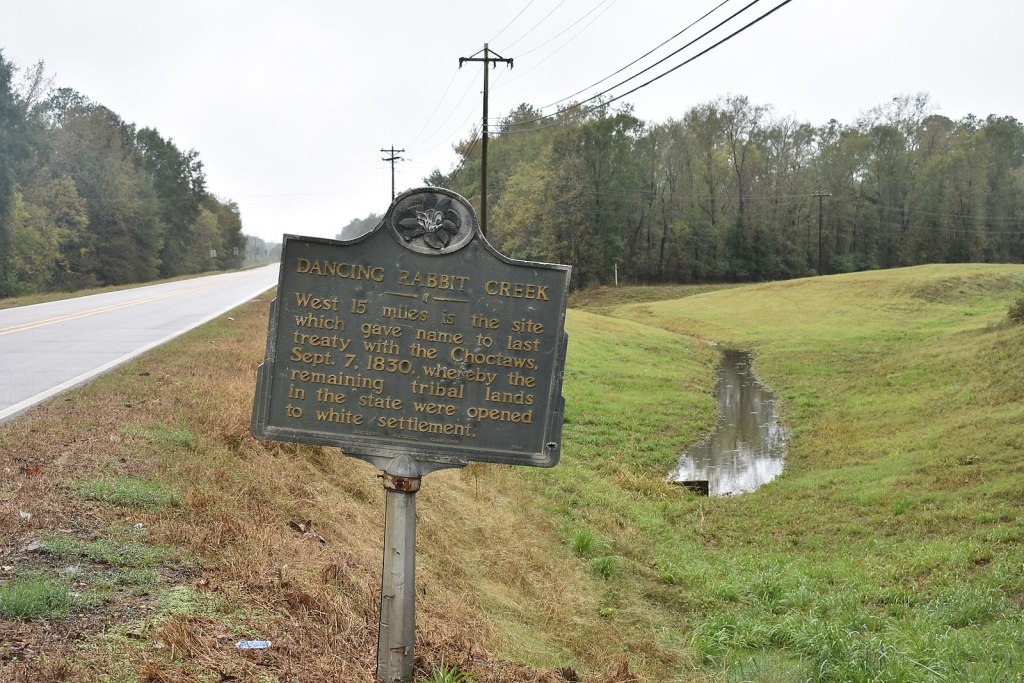
‘A treaty of perpetual friendship, cessation and limits…’ so begins the text of The Treaty of Dancing Rabbit Creek, signed exactly 195 years ago. Signed by tribal leaders and US government commissioners on September 27 1830, the Treaty put into motion one of the darkest periods in Choctaw history, the forced removal from their lands. Conversely, it is a moment in history that also demonstrates the strength of tribal sovereignty in the face of coercive attempts by the US government to acquire Indigenous lands. On the 195th anniversary of the signing of the Treaty, we reflect on the legacy of Removal and the interpretation of “friendship”, as well as paying homage to the resilience of our Choctaw friends, with whom the people of Ireland have cultivated their own lasting friendship.
Following the Indian Removal Act that was passed by Andrew Jackson in May 1830, the Treaty of Dancing Rabbit Creek was the first of its kind. Activating the process of removal that is known by Choctaw today as the Trail of Tears and Death, the Treaty paved the way for one of the largest land transfers to ever take place in the United States. This legally removed Choctaws from their lands in the south-east and established a new Choctaw base in Oklahoma. Despite the assurances made by the government of the United States that removal would be overseen ‘at their expense, and under the care of discreet and careful persons’ who were supposed to be provide for the Choctaw and be ‘kind and brotherly’ to them, the move–which ultimately took place over two decades–was a brutal and protracted process. Almost 15,500 Choctaw in total migrated west of the Mississippi River to Indian Territory in several waves, although some chose to remain in Mississippi. Around 60,000 people from the Choctaw, Cherokee, Chickasaw, Creek and Seminole tribes were forcibly displaced in total.
Yet reading and remembering the Treaty solely as a document of dispossession occludes the historic role that Choctaw people played in securing their own sovereignty. Knowing that Removal was a possibility, the tribe negotiated throughout the decade leading up to the signing of the Treaty to ensure that their sovereignty would be maintained. Despite histories of coercion, the responsibility to protect and enact tribal sovereignty was central to how tribal leaders navigate deeply uncertain times. It is vital to remember this as we mark the 195th anniversary of the signing. Chief Gary Batton, the 47th Chief of the Choctaw Nation has written about this eloquently in a recent blog post commemorating the Treaty. In this, he entreats tribal citizens to:
‘[R]emember this anniversary of an unjust treaty as what it is – a reminder to always be vigilant; always be striving for a better way; always be in the fight to remain a strong, sovereign nation; always be self-determined to push yourself to be a better Chahta than you were the day before for you and your family. Above all remember what the Chahta Spirit of Faith, Family and Culture stands for. The Chahta Spirit was planted and cultivated by our brave ancestors before us – remember that and always remember what it means to be a proud Chahta.’
The Treaty of Dancing Rabbit Creek opens with a commitment to enshrine ‘friendship’. However, in this context, “friendship” is a term that should perhaps provoke careful thought. Friendship is usually assumed to mean an equitable, just, and mutually respectful relationship; for friendship to be accompanied by ‘cessation and limits’ seems to be a historical contradiction in terms. Yet friendship also means responsibility; it is a bond that must be maintained. The Choctaw-Irish history is often told as a story of friendship that stretches across continents, oceans, and peoples, offering a model of mutual aid that spans centuries. It is a history that is inspiring, particularly given a rising climate of division and fracture. Yet what does it mean to be “sharing lands” in the context of this particular anniversary?
The opening up of tribal lands in the southeastern corner of the United States ushered in new waves of settlement, via which many people (including Irish immigrants) put down roots in a new country. Choctaw (and other tribal) lands became assurances of stability for those embarking on uncertain journeys, even as–at the same time–Choctaw people were forced to undertake extremely difficult and often devastating journeys of their own. It is vital to remember that these lands were and are not equitably “shared”, they were appropriated under duress. The bond that was eventually created between the Choctaw Nation and the people of Ireland is therefore one that must account for and remember the nuances of these historical complexities. To do so is to honour the commitment to friendship that the Choctaw Gift represents.
Understanding and respecting Choctaw sovereignty is at the heart of this historical friendship; on the 195th anniversary of the signing of the Treaty of Dancing Rabbit Creek, we can look to this history to help us better understand our present and shape future relations between nations, citizens, visitors and all others who seek to uphold the principles of equitable and respectful friendship.
 Sharing Lands
Leave a comment