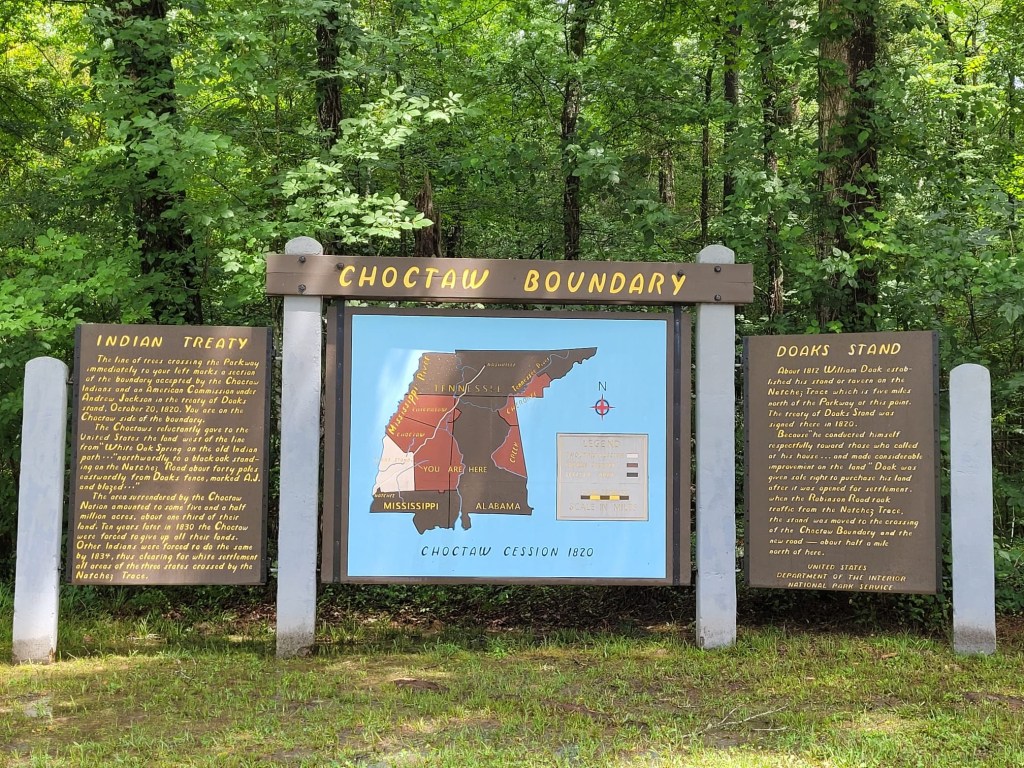
At a remote spot in rural Mississippi, along the old Natchez Trace, is a wooden marker pinpointing the Upper Choctaw Boundary. The site marks a boundary line that was accepted by the Choctaw at an important moment in the tribe’s history. The signing of the Treaty of Doak’s Stand, which took place in October 1820, set the stage for a rapid process of change that, when analysed today, tells a complex and many-layered story of both Choctaw sovereignty and negotiation and, contrarily, symbolises the dispossession of tribal lands that accelerated with the passing of the Indian Removal Act a decade later in 1830.
October 18th 2025 marked the 205th anniversary of this particular Treaty. Signed by Choctaw leaders, the negotiations at Doak’s Stand represent a history of strategic negotiation on the part of the Choctaw in order to secure new lands for the nation. Due to the tribe’s history of fighting alongside Andrew Jackson at both Penascola in 1814 and at the Battle of New Orleans a year later, Choctaw leaders reluctantly agreed to meet with Jackson when he was sent to negotiate the cessation of their lands in exchange for those beyond the Mississippi River. Although many Choctaw leaders outright refused to engage with the possibility of leaving their homelands, the challenge from Washington was ultimately met with delicate, yet firm and ambitious diplomacy, illustrating the hope of Choctaw signatories that the Treaty might offer an opportunity to conserve the nation’s culture, traditions and lifeways in a rapidly changing landscape of increased settlement.
The case of James L. McDonald (often called the first American Indian lawyer) epitomises this delicate sense of balance. McDonald started out by entering into talks in good faith, and can be understood as a proponent of sharing lands and ways of life with the new settlers from Europe. Gradually, though, he came to realise that the aggressiveness of settlement gravely threatened to decimate the Choctaw unless they moved west of the Mississippi. McDonald signed The Treaty of Dancing Rabbit in 1830, seeing this as a means of survival.
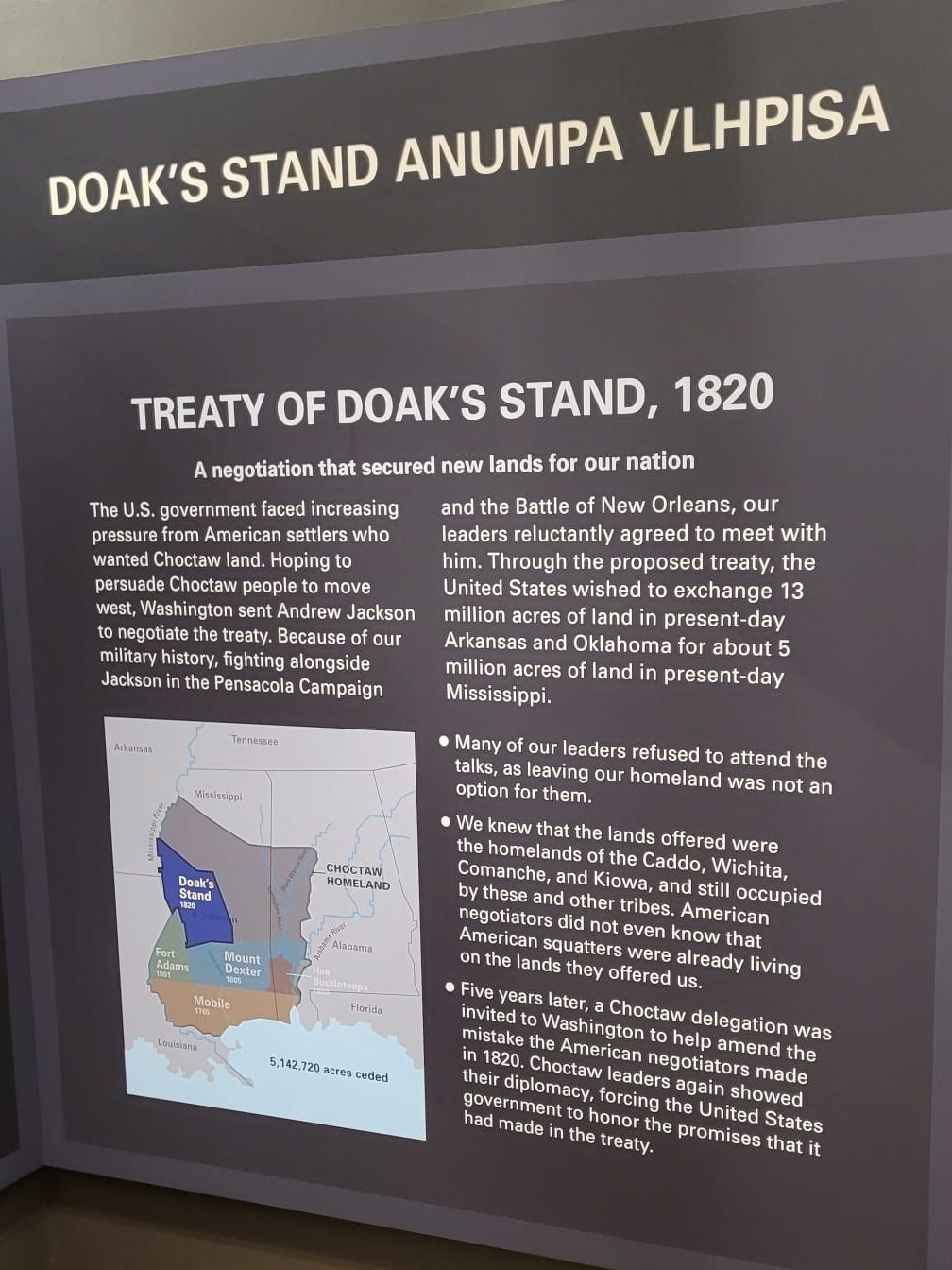
Display detailing the history of the negotiations at Doak’s Stand in the Choctaw Cultural Center
Padraig Kirwan travelled through the Natchez Trace earlier this year when he became the first Irish cyclist to join the Choctaw Nation’s commemorative Trail of Tears Bike Ride. Reflecting on riding the long road from Doak’s Stand to the Headquarters of the Choctaw Nation in Durant, Oklahoma today, he said:
“One simply had to consider both the hardships and loss that the Choctaws endured in the years following Removal in 1830 and the strength of the Nation today. The ceding of tribal lands at Doak’s Stand in 1820, and the death and suffering that followed on the Trail of Tears and Death, are a historical fact; a tenth of the population died en route.”
“The ceding of tribal lands at Doak’s Stand in 1820, and the death and suffering that followed on the Trail of Tears and Death, are a historical fact; a tenth of the population died en route.”
“Nevertheless, the remarkable resilience and growth of the Choctaw Nation of Oklahoma is all the more remarkable in the face of that history. Today, the tribe have over 240,000 enrolled citizens, and are the third-largest Indian Nation in the United States. Today, the tribe reflects every bit of the “optimism…confidence [and] even…[the] exalted enthusiasm for re-establishing Choctaw education, agriculture, culture and commerce” that Philip Carroll Morgan believes was a motivation for the signatories of the Doak’s Stand Treaty.”
“Today, the tribe reflects every bit of the “optimism…confidence [and] even…[the] exalted enthusiasm for re-establishing Choctaw education, agriculture, culture and commerce” that Philip Carroll Morgan believes was a motivation for the signatories of the Doak’s Stand Treaty.”
“Like so many others, this Treaty was signed under duress, but it was also signed as a means to enshrine and ensure sovereignty and survival. Following the road from Natchez Trace to Durant renders those connections and realities clearly for anyone who cares to map out the history.”
 Sharing Lands
Leave a comment