In March 2026, the Sharing Lands team travelled to Oklahoma to record interviews with tribal members and conduct research in museums and cultural centres. Postdoctoral Researcher Dr Shelley Angelie Saggar shares her reflections on the trip.
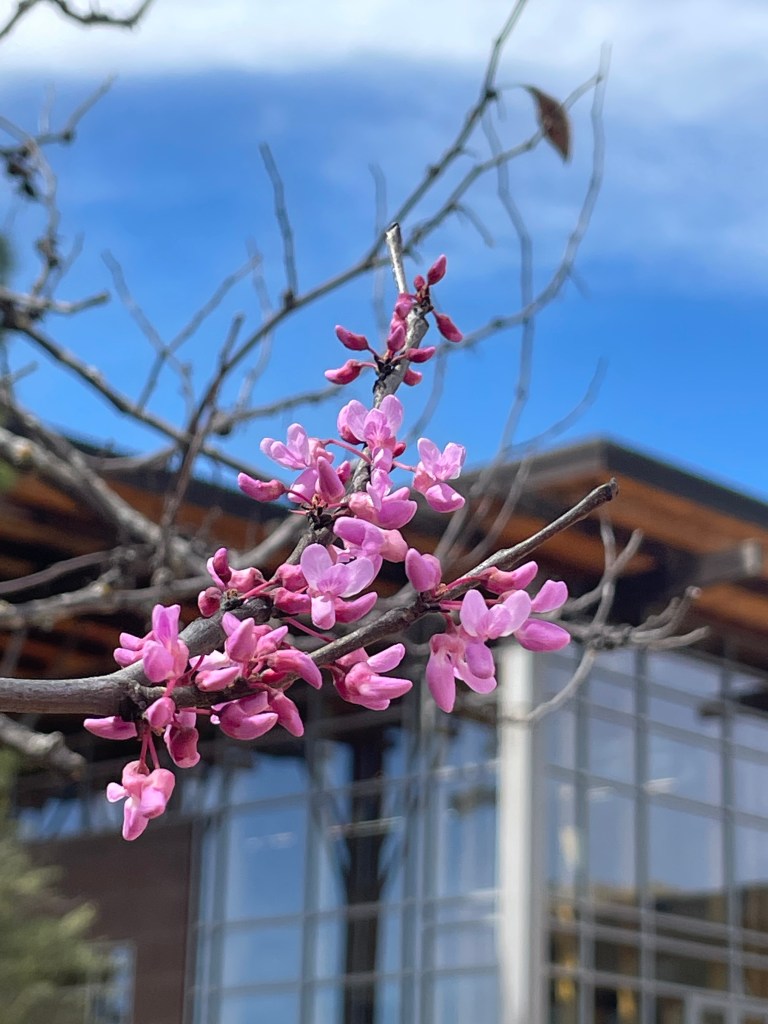
Just over a year after joining the Sharing Lands team, I was lucky enough to make the trip out to the Choctaw Reservation in south-eastern Oklahoma to connect with community members and conduct my portion of the project’s research strands. When we arrived in Oklahoma, it was mid-March, meaning our visit coincided with Mahli Hvshi, the Windy Month. Redbuds lined the roads, their dark pink-purple flowers illuminating the dim early spring light. After becoming so familiar with the history of these lands, it was a privilege to visit, to be physically present in so many sites of historic Choctaw resilience and bear witness to the diverse forms of cultural renaissance that are being nurtured by members of the tribe.
My ambition on the trip was to conduct interviews with tribal members in order to create a Sharing Lands podcast. With the help of Ryan Spring from the tribe’s Historic Preservation Department and friend of the project, we put out a call for contributors. I had not anticipated the level of engagement that we received in response. Consigning my neat and carefully-planned structure for the interviews, I threw myself into listening to people’s stories. The willingness to share of those who spoke to me moved me immensely. After all, I was a stranger; yet people recounted the stories of how their children were named, the intricacies of their craft practices, and welcomed me to listen and learn.
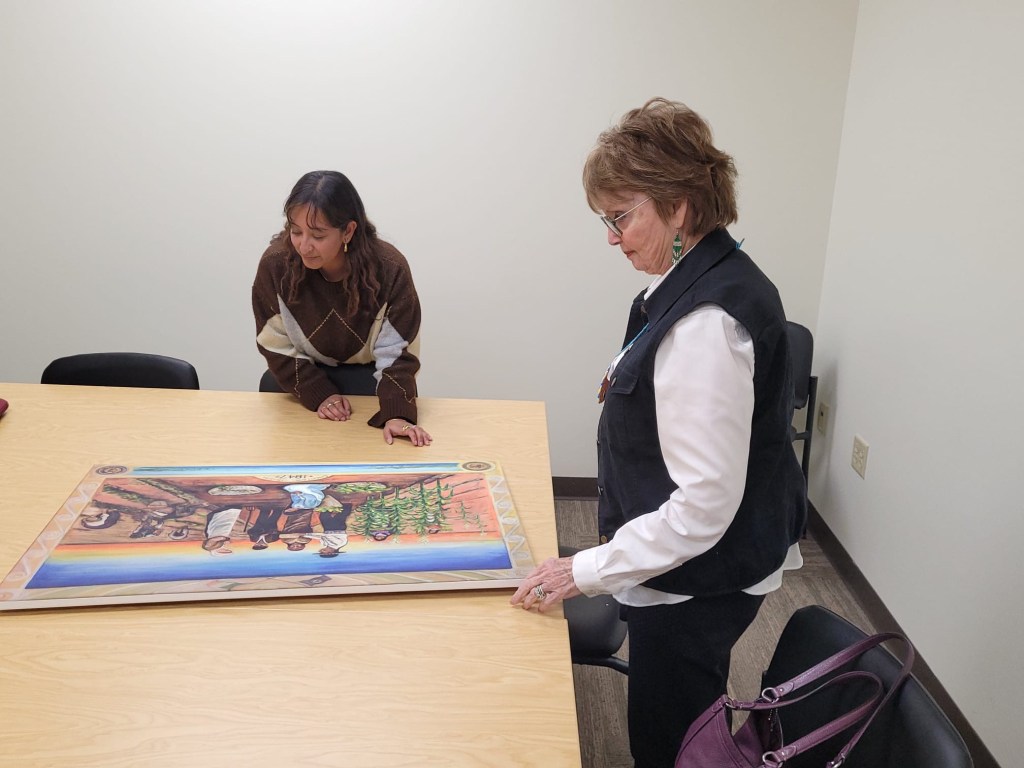
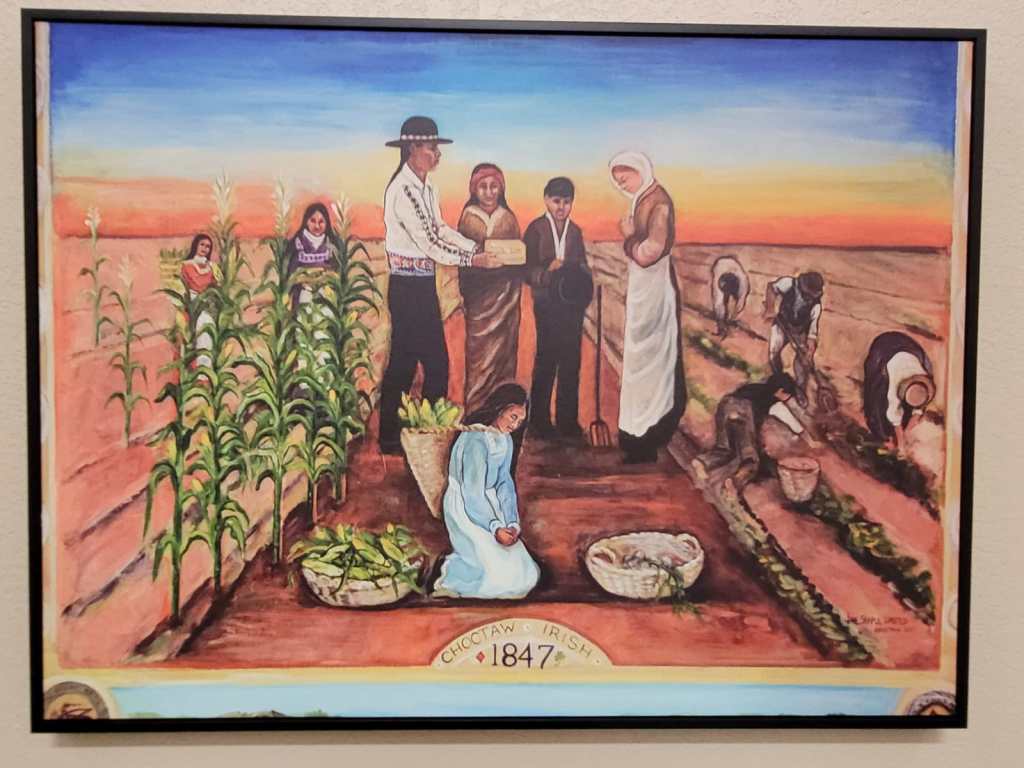
A highlight of these interviews was meeting the Choctaw artist Jane Semple-Umsted, a copy of whose painting Choctaw Gift to the Irish is framed on my office wall at Goldsmiths. As my research on Sharing Lands examines how maize forms a significant, if neglected part of Irish Famine history (given the focus on another Indigenous American crop, the potato) it was an honour to meet the artist behind this powerful expression of visual storytelling. The painting itself depicts the shorelines of Ireland and America, with a central scene showing a gift being given by a Choctaw man to an Irish woman. These central figures divide the two sides of the painting, which in turn depict Choctaw women standing in abundant golden fields of corn that tower over their heads. Opposite them, Irish tenant farmers labour, bent over before a nearly empty harvest basket. The contrast between the two highlights the love and labour of the land, whilst also drawing out what we might think of as themes of food sovereignty and solidarity between distant peoples. Semple-Umsted’s art has informed my thinking about how the maize that was a crucial part of the British government’s Famine relief programme was, in essence, a symbol of Indigenous agricultural history and traditional ecological knowledge. Knowledge of the nixtamalization process, by which maize is prepared for human consumption, was not imported to Ireland along with the maize itself, leading to it being considered inedible and contributing to more suffering.
After leaving Calera and Durant, where the headquarters of the tribe, the casino, and cultural centre are all located, we made our way up through the reservation towards Tushkahoma and Talihena. Following these visits, we headed for Oklahoma City, where a visit to the First Americans Museum was high on our list of places to visit. FAM opened in 2021, and focuses on the 39 federally recognised tribes of Oklahoma. I had read about the museum’s curatorial approach before visiting but was struck by the way in which the OKLA HOMMA exhibit managed to tell the complex stories of each of these tribes, and their histories in coming to Oklahoma, in such a comprehensive manner. After spending time in the two permanent exhibits and also visiting a special exhibition on cradleboards, I ascended the mound at the back of the museum complex that looks back towards the city sprawl. The spiral shaped walkway allows visitors to reflect on the great moundbuilding civilisations and as I walked, looking towards the skyscrapers of Oklahoma City, I was reminded of the Choctaw singer-songwriter Samantha Crain’s words: ‘Okla e maya momakma, tamaha chito okla imihaksi tuko i foni aiyokli ahoba hapiachi kiyo. Okla e maya momakma, napakanli, micha iti, micha nan vpi ahoba osh ohmi tamaha chito okla imihaksi tukon okla il vbachike.’ The song, which is part of the soundtrack to the 2025 documentary Drowned Land, translates as: ‘when we remain, we will not be like the beautiful bones of a forgotten city. When we remain, we will be the flowers and the trees and the vines that overcome the forgotten city’. At the top of the mound, the difference between Indigenous ways of living on the land and the city sprawl were certainly present, but felt more like a relationship than a tension, necessarily. FAM, and, in particular, the museum’s mound, is as much a part of the fabric of the Oklahoma City skyline as the concrete buildings. The lyrics to ‘When We Remain’ remind listeners to be attentive to the beauty in both, and the need to recover relationships that foreground caring for the lands we now share.
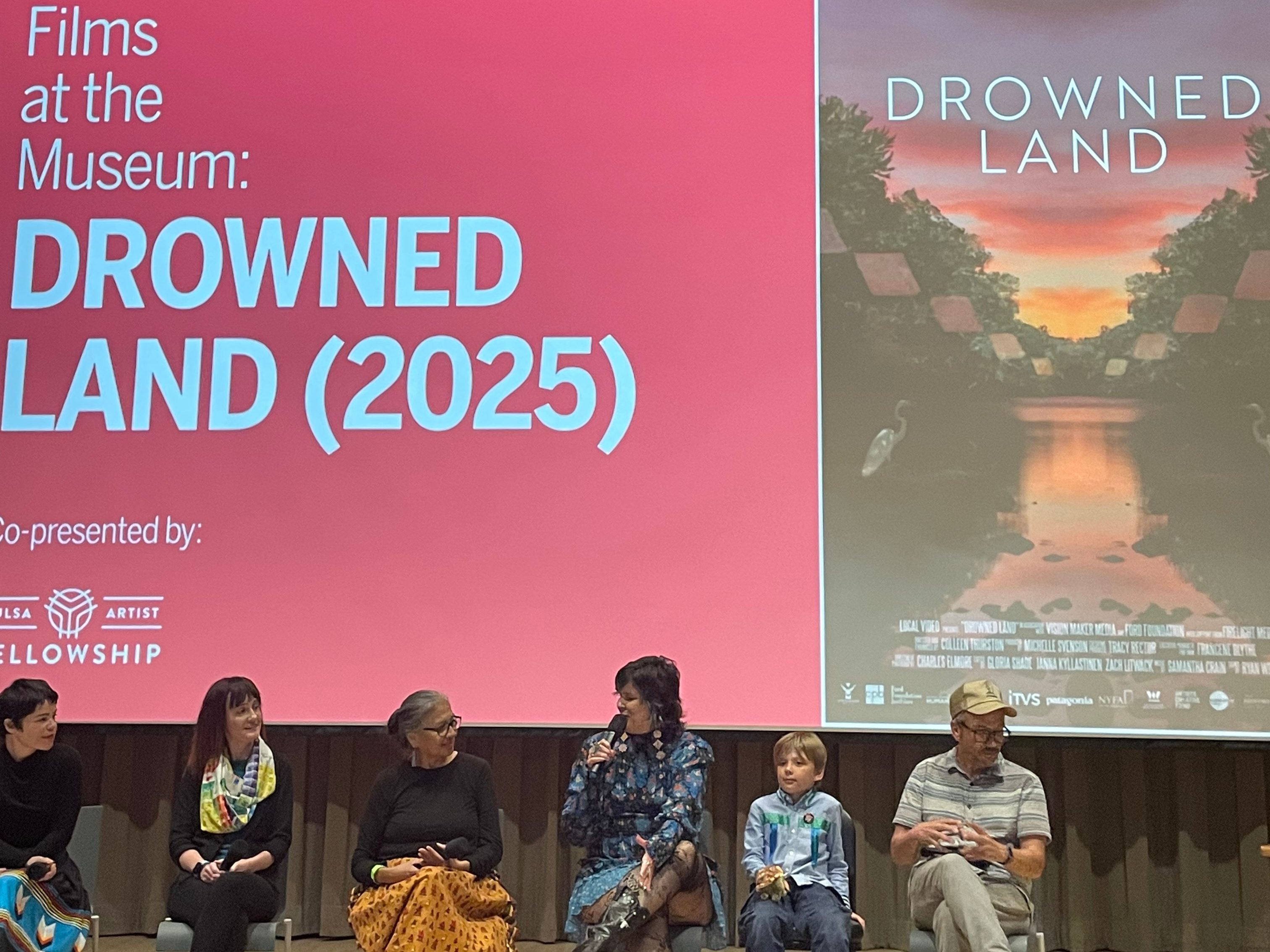
Sam Crain’s songs propelled me into the final part of the trip, a visit to Tulsa to attend a screening of Drowned Land at the Philbrook Museum. Tulsa, a town with a storied history of its own, earned the nickname ‘Magic City’ as a result of the oil boom of the 1920s. 100 years on, this history is inescapable, from the Philbrook, the former home of petroleum businessman, Waite Phillips, to the industrial feel of the city even amidst the refined architectural style of many of the buildings downtown. I had been invited to attend the screening by the documentarian behind Drowned Land, Colleen Thurston, a citizen of the Choctaw Nation living in Tulsa, whose work takes inspiration from the land to allow Native peoples to tell their own stories in their own ways. I encountered Drowned Land early in my research for Sharing Lands, and immediately knew I wanted to connect with Colleen, as her work resonates with questions of narrative, land-based pedagogies, and community coalitions that we were also interested in. It was a privilege to hear from the water protectors who featured in the documentary in a Q&A after the screening. As a result of this visit to Tulsa (where I was kindly hosted by the team behind the Tulsa Artist Fellowship), I am delighted to say that we will be hosting the first UK screening of Drowned Land here at Goldsmiths as part of ‘What the Water Knows’, a two-day symposium exploring Black, Indigenous, and local London community connections to rivers and waterways.
On reflection, visiting Oklahoma gave me a perspective that even well-intentioned research conducted in London never could have done. Spending time with people, listening to their stories, and sharing our own has led to so many ideas, planned projects, and sparked connections that will surely endure beyond the timeframe of this particular piece of research. I am grateful for the opportunity and to everyone who trusted me with their stories, and am looking forward to developing these friendships and connections going forward.
 Sharing Lands
Leave a comment